
About Auditory Perception
Auditory perception refers to how we interpret sound information. Although there are many tests of auditory perception, only auditory discrimination will be considered in this discussion; in particular volume, gap detection, frequency and time order. All of these tasks show a prolonged age normal development reaching their peak level by early adulthood. Of particular interest is the systematic difference in auditory discrimination for students with dyslexia, especially for the frequency and temporal order tasks1 – a finding that is supported by other investigators.2-5
 Regarding training, auditory discrimination can also be trained with improvements in both reading and spelling6-9 although some uncertainty exists around the benefit of auditory training for improving reading.10 The Optomotor Research Group found that the majority of students with problems in the above auditory tasks can improve their auditory skills to age normal levels following 10 days of training in each task, although significantly more difficult in the temporal order task.6 The training involved discriminating fine differences in sound using a small hand-held device. A positive transfer effect to spelling compared to a placebo group was shown (see graph below).
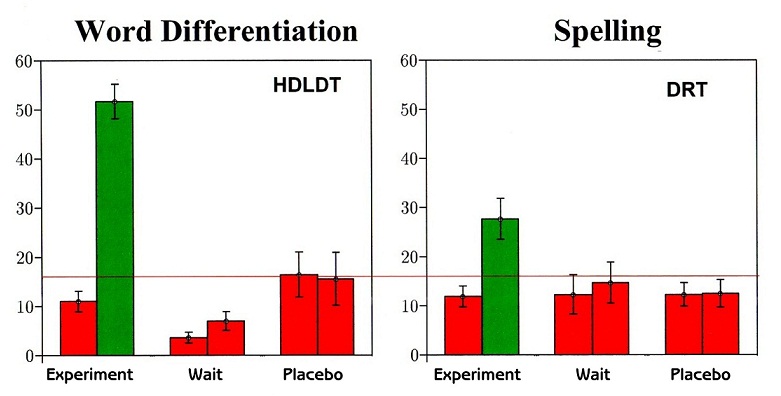
Ref: Dyslexia, 2004
REFERENCES
1. Fischer, Hartnegg. On the development of low-level auditory discrimination and deficits in dyslexia. Dyslexia 2004(10):105-118.
2. Stein J, Talcott J. Impaired neuronal timing in developmental dyslexia – The magnocellular hypothesis. Dyslexia 1999 (5):59-77.
3. Tallal P. Auditory temporal perception, phonics and reading disabilities in children. Brain and Language 1980 (9):182-198.
4. Sharma M, Purdy SC, Newall P, Wheldall K, Beaman R, Dillon H. Electrophysiological and behavioural evidence of auditory processing deficits in children with reading disorders. Clinical Neurophysiology 2006 117(5):1130-1144.
5. Wang H, Huss M, Hamalainen J, Goswami U. Basic auditory processing and developmental dyslexia in Chinese. Reading & Writing 2010, 25(2):509-536.
6. Schaffler T, Sonntag J, Hartnegg K, Fischer B. The effect of practice on low-level auditory discrimination, phonological skills, and spelling in dyslexia. Dyslexia 2004 (10):119-130.
7. Murphy CFB, Schochat E. Effect of nonlinguistic auditory training on phonological and reading skills. Folia Phonoiatrica et Logopaedica, International Journal of Phoniatrics, Speech Therpy and Communication Pathology 2011 63(3):147-153.
8. Gaab N, Gabrieli JDE, Deutsch GK, Tallal P, Temple E. Neural correlates of rapid auditory processing are disrupted in children with developmental dyslexia and ameliorated with training: An fMRI study. Restorative Neurology and Neuroscience 2007 25(3-4):295-310.
9. Hayes EA, Warrier CM, Nicol TG, Zecker SG, Kraus N. Neural plasticity following auditory training in children with learning problems. Clinical Neurophysiology 2003 114(4):673-684.
10. Agnew J, Dorn C, Eden G. Effect of intensive training on auditory processing and reading skills. Brian Lang 2004, 88(1):21-5.